James T Kirk Star Trails – Night Photography at Vasquez Rocks

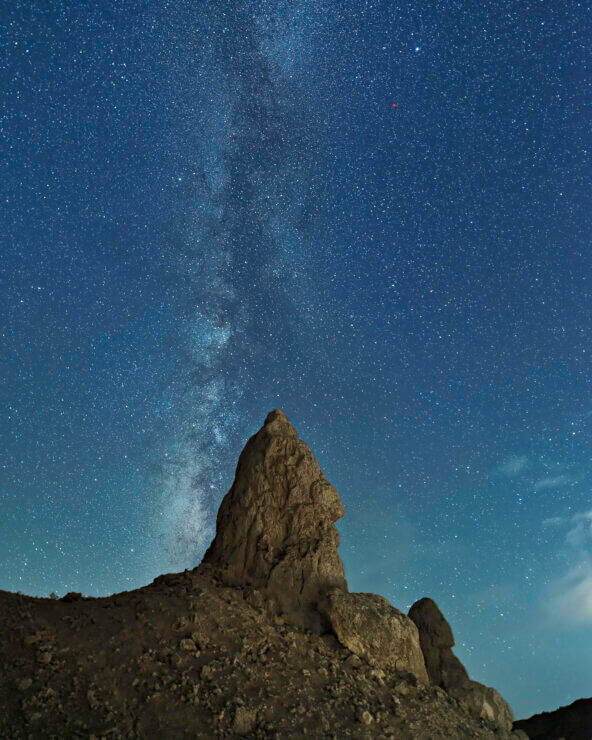
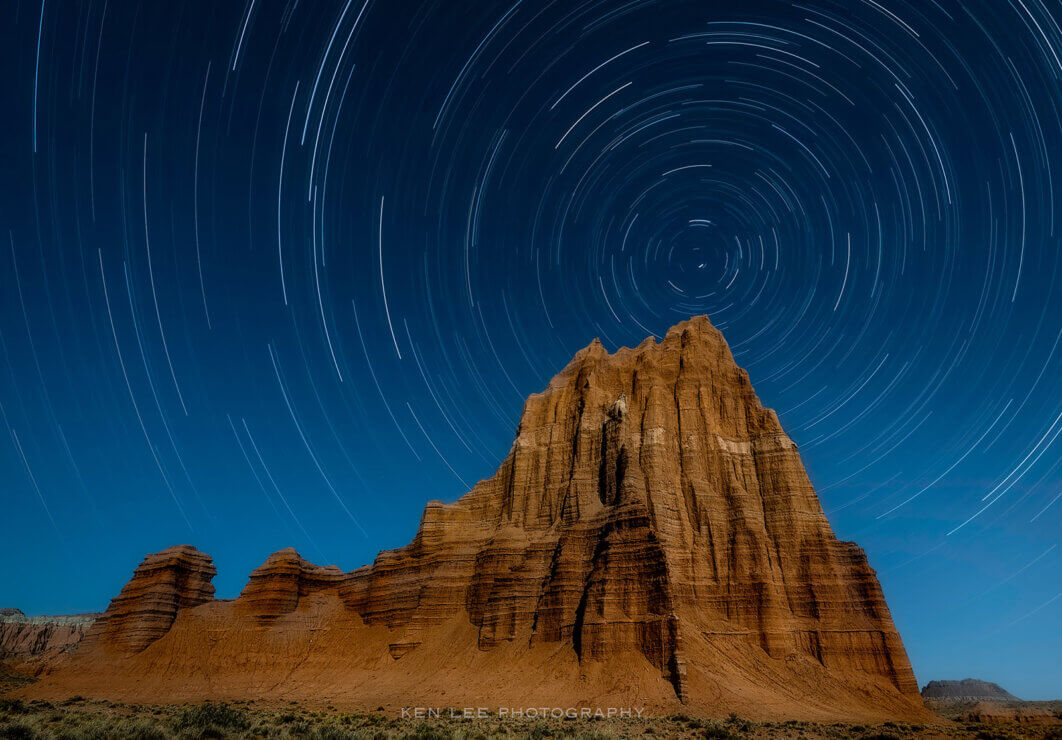
Vasquez Rocks is the location where Captain James T Kirk battled the Gorn lizard man.  And why not?  It’s an otherworldly location where one can easily imagine oneself on another planet.  To push that along further, I photographed this at night during a 60% illuminated moon, shooting star trails to accentuate the alien landscape.

I like to shoot with low ISO, as low as I can get away with, and a noted astronomer and night sky photographer for TWAN (The World At Night, an international team of sky photographers) commented, ”I’ve got to start trying lower ISOs… this is as clean and pretty an image as I’ve seen!”

Perhaps part of it is I am used to using cheap budget DSLRs to shoot night sky photos.  And part of it is that I really don’t like noise.  Unless I put it in there!!  :D
startrails-comettrails-jamestkirk-215minf430siso400-flat

Please click on the photo to view it larger and more clearly!  Thanks!

Title: James T Kirk Star Trails
Info: Nikon D7000, Tokina 11-16mm f/2.8 lens, 33 minute total exposure after stacking. Each individual photo was a 30 second exposure, ISO 400 f/4. Natural lighting. 20 April 2013 1:42 am.
Photographer: Ken Lee
Location: Vasquez Rocks, California, USAThanks for the love and encouragement!

Equipment:  Nikon D7000, Tokina AT-X 116, Feisol tripod.

VISIT ME, VISIT ME!
You can see more of these photos here  on my Ken Lee Photography Facebook Page (poke your head in, say hi, and “like” the page if you would, uh, like). We discuss long exposure, night sky, star trails, and coastal long exposure photography, as well as lots of other things, so I hope you can join us!

And you can go to the Ken Lee Photography website, which has more photos from Ken Lee.  Thank you very much for visiting!


Lyrid Meteor Over Vasquez Rocks – Night Sky Photography

Here’s a special photo, capturing a Lyrid meteor!!!

7442-kenlee_vasquezrocks_lyridmeteor-f430siso400-2

Please click on the photo to view it larger and more clearly!  Thanks!

Title: Stars Dropped Down Like Rain – Lyrid Meteor Shower Over Vasquez Rocks
Info: Nikon D7000, Tokina 11-16mm f/2.8 lens, 30 second exposure, ISO 400 f/4. Mountain light painted with bright flashlight. 20 April 2013 1:19 am.
Photographer: Ken Lee
Location: Vasquez Rocks, California, USA

In 687 BC in Zuo Zhuan, one of the earliest Chinese works of narrative history, described the Lyrid meteor shower: “At night, fixed stars are invisible, at midnight, stars dropped down like rain.”

I was lucky enough to capture this amazing falling star, part of the recurring Lyrid meteor showers that show up typically around late April.

Equipment:  Nikon D7000, Tokina AT-X 116, Feisol tripod.

VISIT ME, VISIT ME!
You can see more of these photos here  on my Ken Lee Photography Facebook Page (poke your head in, say hi, and “like” the page if you would, uh, like). We discuss long exposure, night sky, star trails, and coastal long exposure photography, as well as lots of other things, so I hope you can join us!

And you can go to the Ken Lee Photography website, which has more photos from Ken Lee.  Thank you very much for visiting!


Alien Piano in the Valley of Fire – Night Sky Light Painting Photo

One of the fascinating strange rock formations of the Valley of Fire, light painted at night.

6026_kenlee_valleyoffirepianoarchlightpainting95sf8iso100-700px

Please click on the photo to view it larger and more clearly!  There’s a lot more detail here!  Thanks!

Title: Alien Piano
Info: Nikon D7000, Tokina 11-16mm lens, 95 second exposure at f/8 ISO 100, around 8:30 pm 20 March 2013.
Photographer: Ken Lee
Location: Valley of Fire State Park, NV U
SA

Half moon, seemed really bright with a mind of its own. Red sandstone rocks “light painted”.  I “light painted” The Piano in Valley of Fire State Park with a really bright flashlight, diffusing it with whatever I had available.  But the reddish hue?  That’s the natural sandstone, as the light I was using was a “regular” white light.  I like the texture that the light painting picks up, a texture that might be hard to achieve during the day.

Equipment:  Nikon D7000, Tokina AT-X 116, Feisol tripod.

VISIT ME, VISIT ME!
You can see more of these photos here  on my Ken Lee Photography Facebook Page (poke your head in, say hi, and “like” the page if you would, uh, like). We discuss long exposure, night sky, star trails, and coastal long exposure photography, as well as lots of other things, so I hope you can join us!

And you can go to the Ken Lee Photography website, which has more photos from Ken Lee.  Thank you very much for visiting!


Joshua Tree and Mt. San Jacinto Peak – night sky photos and more!

I rarely link here, but I thought you might be interested in my website that keep of my travels, basically my personal photo album.  This is one from Memorial Day weekend, where we climbed Mt. Jacinto Peak and then explored Joshua Tree National Park.  

startrails-quailsprings30sf28iso250-50min-700px

As you might expect from me, there’s a lot of night sky photos and star trails. Just like here, I give settings for long exposure photos.  Because, well, why not?

7922_kenlee_joshuatreenightskyf28iso40015s-parkblvd2-700pxEnjoy!

7760_kenlee_sanjacintopeak-topofpeak

Me at the top of Mt. San Jacinto Peak at 10, 834 ft./3302 meters, a good warm-up for my trip to the Himalayas later this year!

VISIT ME, VISIT ME!

You can see more of these photos here  on my Ken Lee Photography Facebook Page (poke your head in, say hi, and “like” the page if you would, uh, like). We discuss long exposure, night sky, star trails, and coastal long exposure photography, as well as lots of other things, so I hope you can join us!

And you can go to the Ken Lee Photography website, which has more photos from Ken Lee.  Thank you very much for visiting!


Star Trails Over Quail Springs, Joshua Tree – Long Exposure Time Lapse Photography

When I’m shooting north-facing photos, I really love to place Polaris as interestingly as I can in the frame. Here, I’ve managed to place it at the pinnacle of the cliff to accentuate the trails and draw the eye to the pinnacle more.

startrails-quailsprings30sf28iso250-50min-700px

Please click on the photo to view it larger and more clearly!  Thanks!

This whole scene was lit by a full moon, with no light painting of any kind.  The light of the full moon was so bright that I think I may have been able to read a book!!

I hope you enjoy the photo, and thank you for stopping in!

Title: Quail Springs Rocks Star Trails
Info: Nikon D7000, Tokina f/2.8 11-16mm. Stacked photo consisting of 99 individual photos of 30 second exposure f/2.8 ISO 250 each, taken 11:20 am 25 May 2013. 49 and a half minutes total exposure. Lit by moonlight only.
Photographer: Ken Lee
Location: Joshua Tree National Park, CA
USAThank you so much for your love and encouragement! -Ken

Equipment:  Nikon D7000, Tokina AT-X 116, Feisol tripod.

VISIT ME, VISIT ME!
You can see more of these photos here  on my Ken Lee Photography Facebook Page (poke your head in, say hi, and “like” the page if you would, uh, like). We discuss long exposure, night sky, star trails, and coastal long exposure photography, as well as lots of other things, so I hope you can join us!

And you can go to the Ken Lee Photography website, which has more photos from Ken Lee.  Thank you very much for visiting!


Temple Tree Star Trails in Amazing Zion National Park, Utah

Mystical Temple Tree Star Trails in Zion National Park, a 50-minute exposure in total.

startrails-templetreezion3-kenleeblend2-700px

Please click on the photo to view it larger and more clearly!  

Title: Temple Tree Star Trails
Info: Nikon D7000, Tokina 11-16mm lens at 11mm. This is a combination of 100 individual photos, with each one 30 seconds, f/4.5 ISO 400, all stacked together for a total of 50 minutes. Tree illuminated by the infernally bright moon and headlights of a car. Taken around 11:00 pm 22 March 2013.
Photographer: Ken Lee
Location: Zion National Park, Utah U.S.A.

I had this really great idea for this photo, I really did.  I was aimed the other way, attempting to shoot the the large rock cradled in the cathedral of rocks here at the Temple of Sinawava.  But the super bright moon seemed determined to have its way with my wide angle lens, appearing wherever I seemed to aim it.  I looked up at the stars in the other direction, and saw how beautiful the moonlight shone on this tree.  Sometimes it’s good to look the other way.  A good photo may be lurking in that direction.

Equipment:  Nikon D7000, Tokina AT-X 116, Feisol tripod.

VISIT ME, VISIT ME!
You can see more of these photos here  on my Ken Lee Photography Facebook Page (poke your head in, say hi, and “like” the page if you would, uh, like). We discuss long exposure, night sky, star trails, and coastal long exposure photography, as well as lots of other things, so I hope you can join us!

And you can go to the Ken Lee Photography website, which has more photos from Ken Lee.  Thank you very much for visiting!


Photo: Valley of Fire and the Dangers of Night Photography, Oh No!

Our Celestial Blanket

In the Valley of Fire, I kept finding all these amazing rock formations.  The moon was bright, so bright I could have read, and I could easily see Valley of Fire’s stunning rock formations.

Title: Our Celestial Blanket
Info: Nikon D7000, Tokina 11-16mm lens. Blend of two photos: 1.) light painted rocks photo was a 143-second exposure at f/4 ISO 100; 2.) sky photo was a 20-second exposure at f/2.8 ISO 800 taken 20 March 2013 at 9:00 pm.
Photographer: Ken Lee
Location: Valley of Fire State Park, Nevada U.S.A.

YEEEOOOOOUCH!!!!
Light painting in the dark is not without some hazards. I’ve bashed my foot into cacti and tripped over rocks and run into shrubbery. For this shot, I scratched up both hands light painting this very photo, running into the long branch of a thorny bush and catching it on my hands, raking along my skin. After I finished this photo, I looked down and saw both my hands covered in blood. Whooops!  I am writing this about three weeks later, and I still have about 6-7 visible marks on each of my hands from that bush!

It’s so hard to see where you are going.  After I mentioned this on my Photography Facebook Page, someone mentioned that they had jacked their knee up doing light painting.  After all, light painting is a very active sort of photography, involving a lot of moving or running around, waving flashlights or other things around.  In the dark.  So sometimes, stuff can happen.

Amazing how we suffer for our art.  :D

Thanks so much for reading and commenting! -Ken

Please click on the photo to view it larger and more clearly!  Thanks!

Equipment:  Nikon D7000, Tokina AT-X 116, Feisol tripod.

VISIT ME, VISIT ME!
You can see more of these photos here  on my Ken Lee Photography Facebook Page (poke your head in, say hi, and “like” the page if you would, uh, like). We discuss long exposure, night sky, star trails, and coastal long exposure photography, as well as lots of other things, so I hope you can join us!

And you can go to the Ken Lee Photography website, which has more photos from Ken Lee.  Thank you very much for visiting!


Photo Tip: 3 Steps To Star Trails with Comet-Like Tails!!! Big Bend in Zion National Park

Big Bend Star Trails

A lot of you have asked how I create star trails that look like comets, so I’m gonna write about it, and that’s very sweet of me.  :D

I will discuss how to do this in Photoshop because, well, this is how I do it, but also, to the best of my knowledge, automated stacking programs such as startrails.exe ain’t gonna let you do this.  In case it matters, I’m using Photoshop CS4, but you should be able to do this in any version of PS that allows you to stack.  Awright…..now we’re just three steps from star trails with comet tail bliss!!

This tutorial assumes that you know how to take and process photos into star trails already.  If you don’t, visit here.

1.  CREATE STACK: In Photoshop, you select File > Scripts > Load Files Into Stack, and then select the files you wish to stack and follow the prompts accordingly. This will result in a HUGE .PSD file, with 50, 80, 120 layers, however many you loaded.  And if you’re like me, they’ll be TIFFs.  16-bit TIFFs.  Yeah.  Have patience knowing that your computer is working very hard to make you happy right now.

2.  ADJUST LAYERS:  In the MODE PANEL WINDOW (which is the window that controls the Layers, etc. at the bottom right), change each layer from “Normal” to “Lighten”.
Some people occasionally use one of the other ones (such as screen, color dodge, linear dodge, lighter color), but “Lighten” is the most common, so whaddaya say we stick with it, cool?  Do this for each Layer.  Yup.  That’s a lot.  You can probably find a Photoshop Action for this if you Google around.  And for that matter, you can probably find it for much of this star trails or comet tail creating process.  Or you could create it yourself.  I have not yet.  No, I don’t know why I haven’t.
3.  ADJUST OPACITY:  Have you gotten carpal tunnel syndrome changing all your layers to  ”Lighten”?  Great.  Now, you can exacerbate that further by changing all of your layers’ Opacity.  Y’see, the opacity defaults to 100% for each layer, so right now, you should have “normal” star trails that look like curved lines.  What I do by this point is I make a flattened TIFF file of this in case I decide later that I really do want to have “regular” star trails.

Okay, back to adjusting opacity.  Right next to the pulldown menu on the MODE PANEL WINDOW where you just changed all your layers from “Normal” to “Lighten” is another smaller pulldown menu that says “Opacity”.  It defaults to 100%.  So what you’re going to do is start from the top, and one by one, change each layers’ opacity to…well, something less than 100%.  You start at 100% and gradually reduce the opacity until the last layer has a really low opacity, like 2% or 5% or whatever you think looks great.  As you go along, you’ll slowly see the star trails begin transforming into comet trails, although the last part will remain full and bright until you adjust the very last Layer.  After that, you should see the results of all that clicking.  You should see each trail looking like a comet tail.

~~~~~~~

BACKGROUND INFO ABOUT THIS NIGHT SKY PHOTO OF BIG BEND IN ZION NATIONAL PARK:
So hey, about this photo….here’s a little more about how it came to be!  I’m one of these people who are fascinated by the creative process, so I get into this kinda thing!

For this photo, I had to move the camera a couple of times. The moon seemed to be turbo-charged, cruising across the canyon sky too quickly. I moved the camera further over to the right, also a great view, and felt satisfied. I had The Organ bracketed by the Great White Thrown on the left and Angels Landing on the right, and all seemed good.

I had seen another photo of this taken by a photographer, one of the Milky Way. He and his son had set up this elaborate array of strobe lights, constant incandescent lights, and dish reflectors – all in all, five lights, placed 500 to 700 feet away from the camera, with strobes set to trigger via radio command. It was quite a setup.

I therefore was extremely surprised when I shined my Dorcy flashlight on The Organ and found that I could actually illuminate it even though it was monstrously huge and fairly far away. And sure, while the Dorcy is a very strong flashlight, almost like holding a car headlight in your hand, it still seemed absurd that I could do this. So I took one photo relatively early on, illuminating The Organ, and then began taking the sequence of shots to stack into a star trails photo, eventually blending the two together in Photoshop.

Title: Big Bend Star Trails
Info: Nikon D7000, Tokina 11-16mm lens. This is a combination of 54 individual photos, with each one 30 seconds, f/2.8 ISO 125, all stacked together for a total of 27 minutes. The photo of the stacked photos was blended with another photo of the foreground, consisting of The Organ (center), Great White Throne (left) and Angels Landing (right), which was shot at 52 seconds f/2.8 ISO 250. The Organ was light painted with a Dorcy spotlight. Taken around 10 pm 22 March 2013.
Photographer: Ken Lee
Location: Zion National Park, Utah U.S.A.

Equipment:  Nikon D7000, Tokina AT-X 116, Feisol tripod.

VISIT ME, VISIT ME!
You can see more of these photos here  on my Ken Lee Photography Facebook Page (poke your head in, say hi, and “like” the page if you would, uh, like). We discuss long exposure, night sky, star trails, and coastal long exposure photography, as well as lots of other things, so I hope you can join us!

And you can go to the Ken Lee Photography website, which has more photos from Ken Lee.  Thank you very much for visiting!


Joshua Tree: Stone And Tree Revisited

Please click on the photo to view it larger and more clearly!  Thanks!

joshuatree0213_234and239-stoneandtreeBW

I returned to this stone and tree location to try another photo.  This time, instead of clicking a photo quickly as I was walking past, I took my time and set up the shot with a tripod.  I am thinking of printing this one to hang on the wall in at Blueberry Buddha Recording Studios (I’m also a recording engineer).

This one is a blending of two photos, one shot for a general overall exposure, and the other  exposed for just the foreground tree.  I then simply blended the foreground tree in a bit, a sort of handmade HDR to create a little more dynamic range in the photo.  I could have also done it by illuminating the tree with a flash, but was happy with blending them as well. Whatever works.

Equipment:  Nikon D7000, Tokina AT-X 116, Feisol tripod.

See some more photos from our trip to Joshua Tree in February 2013!

VISIT ME, VISIT ME!
You can see more of these photos here  on my Ken Lee Photography Facebook Page (poke your head in, say hi, and “like” the page if you would, uh, like). We discuss long exposure, night sky, star trails, and coastal long exposure photography, as well as lots of other things, so I hope you can join us!

And you can go to the Ken Lee Photography website, which has more photos from Ken Lee.  Thank you very much for visiting!


Joshua Tree: Trinity Stars (Night Sky Photography)

Trinity Stars, a three-trunk tree, spreading out before the glorious night sky.

Please click on the photo to view it larger and more clearly!  Thanks!

joshuatree0213_455threetrunk30sf4iso500-ALSOUSEASBLENDFORSTARTRAILS

Title: Trinity Stars
Info: Nikon D7000, Tokina 11-16mm f/2.8 lens, Dorcy LED flashlight for “light painting” the rocks and the trees. 30 second exposure, f/4, ISO 500.
Photographer: Ken Lee
Location: Joshua Tree National Park, CA USA

I love this three-trunk Joshua Tree reaching up to the stars.

This is a long exposure shot in which I again had to try and hurry the “light painting” component of the shot to try and capture the stars as pin points.  To keep stars as pin points, I usually prefer to keep the exposure under 20 seconds to avoid them appearing as small star trails, but with a lens as wide as 11mm, one can get away with a little more sometimes.  Anyway, my running around with a flashlight seems to have paid off…this is “light painted” pretty well.  The bright moon added even more light to the rocks, creating some shadows in addition to my light source.

A beautiful evening!!!!!

Equipment:  Nikon D7000, Tokina AT-X 116, Feisol tripod.

VISIT ME, VISIT ME!
You can see more of these photos here  on my Ken Lee Photography Facebook Page (poke your head in, say hi, and “like” the page if you would, uh, like). We discuss long exposure, night sky, star trails, and coastal long exposure photography, as well as lots of other things, so I hope you can join us!

And you can go to the Ken Lee Photography website, which has more photos from Ken Lee.  Thank you very much for visiting!